
“You Are Part of the Church”
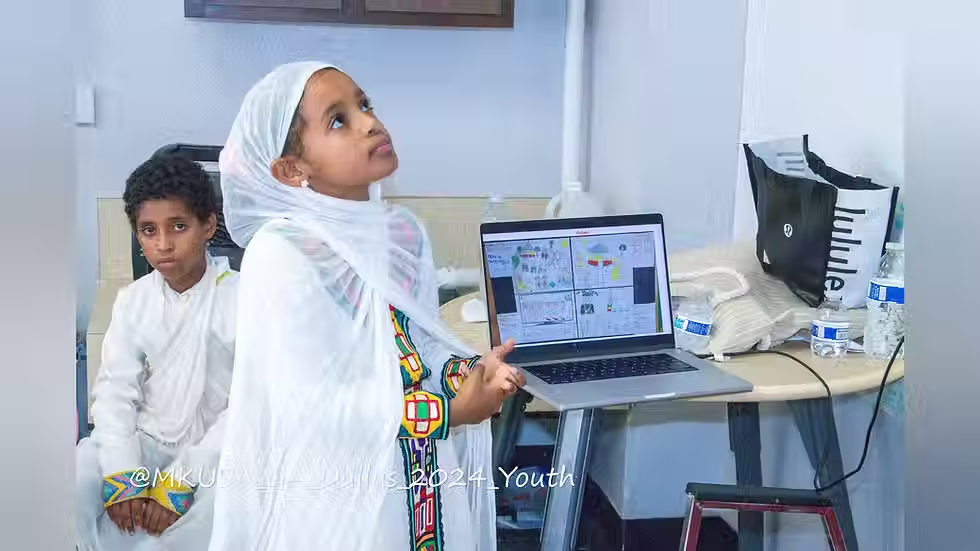
When Sammy’s parents told him that their family would be traveling from Ohio to Dallas for a three-day Ethiopian Orthodox summer camp, he had little interest in going. They had encouraged him to attend church and participate in Sunday school for years, and while he usually complied, he did so more out of obligation than enthusiasm. Summer was supposed to offer a break, and he hoped to spend it another way. His parents brought him anyway.
When the family arrived, Sammy encountered a form of welcome he did not expect. Another child, close to his own age, knelt and washed his feet, following the example of Jesus washing the feet of his disciples.
“He was so surprised,” said Mengistu Kassie, Project Manager at Mahibere Kidusan Coordinating Center in North America. “A child his age was kneeling down and washing his feet. He was asking, ‘You are washing my feet?’”
Over the next several days, Sammy joined hundreds of children for worship, teaching, music, art, games, and friendship, learning about the love of God while experiencing that love through the hospitality of other children. By the end of the camp, something had changed in Sammy’s perception of God and the church he belonged to.
“He said, ‘God loves me this much? These people are doing this for me because God loves me,’” Mengistu recalled. Sammy began asking his parents how he could participate more in his church’s ministries, and whether he could return to summer camp the following year. This child who had been reluctant to attend church became one of the first to register for future events and even began inviting his friends to join!
“Before, he was the one people had to ask, ‘Would you please attend?’” Mengistu said. “Now he is the front-runner inviting other children.”
Sammy’s experience reflects the hope at the center of Mahibere Kidusan’s work: that children growing up between Ethiopian and American cultures would understand that the Orthodox faith belongs to them, and that they belong within the life of the church.
In many Ethiopian families in the United States, parents and children may approach authority, language, faith, and family life from very different cultural starting points. Mengistu describes the Ethiopian culture in which many immigrant parents were raised as communal and hierarchical. Parents gave direction, children listened, and neighbors, clergy, and other adults also shared responsibility for guiding young people.
“If you are a parent, you have the upper hand,” he said. “You speak, and the children listen. The neighbors, if they find you on the street, have the right to instruct you. The parents, the community, and the church fathers, all of it is collective.”
Many children born and raised in the United States expect a more collaborative and less authoritative approach to community and hope that parents and leaders will explain the reason behind an instruction. “They believe in reasoning,” Mengistu said. “They want to know why. When I say, ‘Do this,’ they ask why, and the parent should justify it.”
Parents can hear those questions as disrespect, while children may interpret a parent’s firmness as a lack of affection or understanding, and those misunderstandings can intensify as children enter adolescence.
“When parents say, ‘My children do not listen to me,’ the children may say, ‘They do not love us. Why should I listen to them? Even the church community does not love me, so why am I going?’” Mengistu reflected.
Language adds another layer. Mengistu, like many Ethiopian Orthodox immigrant parents, began speaking English later in life, while children born in America are more likely to speak English as their primary or only fluent language.
Christian Parenting and Caregiving Grant Multiplies Mahibere Kidusan Coordinating Center’s Impact in North America
Mahibere Kidusan’s Christian Parenting and Caregiving Initiative was designed with this particular cultural and spiritual reality in mind. Thanks to the funding of Lilly Endowment Inc.’s Christian Parenting and Caregiving Initiative, their team is piloting bilingual materials, leadership training, and family programs that help parents understand the experiences of children growing up in the United States while also giving them greater access to the theology and practices of the Ethiopian Orthodox tradition.
“There should be a mechanism that bridges these two,” Mengistu said, “that helps the parents understand their children and helps the children understand their parents. This initiative is a powerful resource for bridging that cultural barrier.”
The work has also prompted clergy and church leaders to reconsider their role in children’s spiritual formation. Mengistu told the story of an energetic young church leader from Atlanta who attended Mahibere Kidusan’s Christian Parenting Training of Trainers (ToT). The leader considered himself progressive and familiar with the American context, yet the training revealed that his ministry focused almost entirely on adults.

“He realized that when he talked about the Christian faith, he never thought about speaking to children,” Mengistu said. The leader returned home convinced that priests, deacons, educators, and the wider congregation share responsibility for helping children grow in faith. “Until I came here and took this training, I never understood that we should intentionally arrange time to teach the children and ask the children questions,” the leader said. “They are part of the church.”
After the leader shared his experience through Mahibere Kidusan Television, churches across the country began asking for the same training. Mahibere Kidusan’s English and Amharic curriculum has now equipped leaders who have reached more than 875 parents, educators and clergy.
Children are also finding their place through sacred music. Mahibere Kidusan has acquired 100 traditional instruments and trained young people to play them as part of Orthodox worship. Because many children speak English more fluently than Amharic or Ge’ez, young adults and campus ministry students translated hymns into English.
“The children were very eager to translate that language into English and to study the hymns in English,” Mengistu said. “Once we started, the children were very happy. They loved it.”
Some congregations now invite children to lead sacred music each month. Mengistu’s daughter is among the students learning to play the harp, and she makes sure the family keeps those Sundays free. “‘Mom, Dad, you may have another program, but I have to be ready to lead in church,’ she says,” reflected Mengistu.
“It keeps the children feeling that the church is for them,” he said. “They are part of the church, and they are singing in their own language.”
Mengistu sees that sense of ownership in daily life as well. Children ask for English Bibles, initiate prayer before meals, sing with their families, and invite friends to church. Summer camps that once served fewer than 100 children reached more than 400 in 2024, followed by more than 800 registrations across four cities in 2025.
“They were waiting to hear, ‘You are part of the church. We understand you. You have the right to worship in your language and in your culture,’” Mengistu said.
Mahibere Kidusan is working to help Sammy’s story be replicated in other Ethiopian Orthodox Churches, by equipping parents to be cultural guides, helping congregations be faithful storytellers, and helping children be faithful translators, leading their congregations into faithfulness across generations, so that (at every age) participants in the church can find their place as stewards of their tradition of faith.

